What Murmur's free version does, and what a licence adds
21 Aug 2026
Murmur's free version is not a trial. Nothing counts down, nothing expires, it does not go quiet after ten minutes and it does not degrade the output. It is a finished granular instrument that happens to be a subset of a larger one, and plenty of people will never need the rest. This page is what is in each half, taken from the manual's own table rather than summarised into something friendlier.
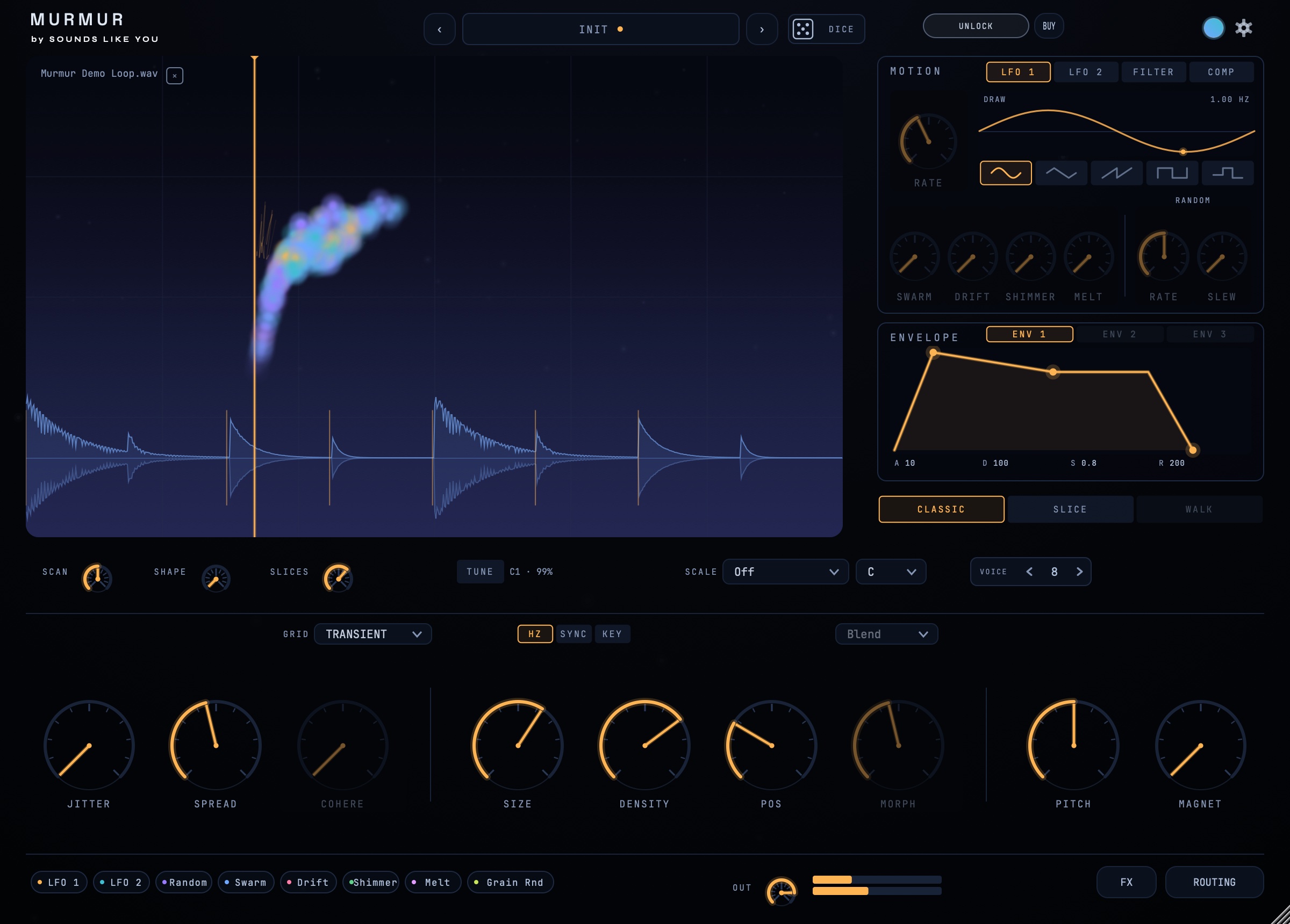
Flip that toggle a few times. Same patch, same window: what changes is which controls are lit. A paid control is never hidden and never removed, it sits exactly where it will be when you unlock it, dimmed, and it still answers a hover with a tooltip saying what it does. The drawer tabs stay clickable for the same reason, opening to a legible panel under a veil rather than a locked door. Nothing dim is broken.
What you get for nothing
The whole grain engine, is the short answer. Loading any sample by drag and drop or file dialog. POS, SCAN, DENSITY, SIZE, SHAPE and PITCH. JITTER, SPREAD, MAGNET and SLICES. All three grain clocks, HZ, SYNC and KEY, including the sync division. CLASSIC and SLICE play modes, editing slice boundaries on the waveform, the GRID divisions and CLEAR/DETECT. The ENV 1 amp envelope with its slope curves. TUNE, SCALE, VOICES, GLIDE, OUT and the meter. DICE, the cloud colour, and loading any preset, including all nine starter templates.
Every article on this site so far has been written against the free version on purpose. The pad recipe, the drone bed, the vocal chop, the overlap numbers: none of it needs a licence.
What the licence adds
| Unlocks | What it is for |
|---|---|
| MORPH and the second sample layer | Grains taken from two sounds at once, with a MATCH pill that transposes the second onto the first one's key. One source becoming another across a cue. |
| COHERE | Locks grain timing, position and length to the sample's own pitch, folding a cloud into a solid tone you can play chords with, level-matched. |
| WALK and its step sequencer | The read point steps through slices in time, with per-step offset, level, pitch and seeded probability. |
| ENV 2 and ENV 3 | Two more envelopes with the same handles and curves, pointed at anything through the routing matrix. |
| REPEAT | Grains locked to the exact grid gap at your actual tempo. A beat repeat that survives a tempo change. |
| G-FILTER and G-COMP | Per-grain filter and compressor, on the MOTION card. Every grain can take its own colour. |
| The FX rack | All seven modules, its bypass, and its modulation destinations. |
| Everything that modulates | LFO 1 and 2 including drawn shapes and grain sync, RANDOM, GRAIN RND, the four macros, the source badges, the mod rings and the ROUTING matrix. |
| Saving your own presets | The free version loads any preset, including all nine templates. Writing your own back out is paid. |
The honest dividing line
Read that list again and a pattern falls out of it. The free version is a complete instrument you play with your hands. The licence is mostly about things that move on their own or stack up: modulation, a second layer, a sequencer, an effects rack, per-grain processing, and the ability to keep what you built.
So the question is not really about features. If you are dropping a sample in, finding a sound and printing it, the free version does that and will keep doing it. If you are building patches you want to come back to, or you want the sound to evolve over eight bars without you holding the dial, that is the paid half and there is no way around it. Saving presets is the one that usually decides it, because it is the difference between a tool you visit and a tool you live in.
It is a one-off $34.99 at the moment, down from $59, on as many machines as you own. No subscription, and updates are included.
If you have not heard what it does yet, the granular explainer lets you drive the engine in the page, and the pad recipe builds something usable in about four minutes on the free tier.