Murmur vs Audio Damage Quanta 2: two granular instruments
22 Aug 2026
I make one of these two, which you should factor in. Quanta 2 is also the plugin I would point someone at if Murmur turned out to be the wrong shape for them, so this is a comparison rather than a pitch. Unlike most granular pairings, these two really are competitors: both are instruments, both load your own audio, both are played from a keyboard.
The difference is what surrounds the grain engine. Quanta is a synthesiser that happens to have a granular oscillator in it. Murmur is a sampler-shaped instrument built around slicing and playing a recording. That one sentence predicts almost every difference below.
Where the depth sits
Same grain engine at the centre, very different things around it
Flip that and the disagreement is visible in one picture. Quanta puts three sound sources into two routable filters; Murmur puts one recording and its slice boundaries into a grain engine. Neither is missing something the other has by accident.
Quanta is the bigger synth
This is not close, and it is worth being clear about. Alongside the grain engine Quanta 2 carries two virtual analog oscillators with pulse width modulation and a noise source with a colour control, so you can build a patch that is only partly granular. It has dual multi-mode filters, lowpass, highpass, bandpass and notch, in 2-pole and 4-pole, routable in series or parallel. Four envelope generators of up to 99 steps each, which is a step sequencer wearing an envelope's clothes. Two tempo-syncable LFOs, sample and hold, four macros, and chorus, stereo dual delay and reverb built in.
Its grain engine is generous too: up to 100 simultaneous grains per voice, at up to a second each. If what you want is a deep synthesiser where granular is one of several sound sources you can filter and modulate against each other, Quanta is straightforwardly the better instrument and I would not try to argue otherwise.
It also runs in more places
Quanta 2 ships CLAP, VST3 and AAX on Windows; CLAP, VST3, AU and AAX on macOS; CLAP, VST3 and LV2 on Linux; and standalone plus AUv3 on iPad. Murmur is VST3, AU and standalone on macOS and Windows, and that is the whole list. No Pro Tools, no Linux, no iPad, no CLAP. If you are on Linux or working on an iPad, this comparison is already over.
Murmur is built around the recording
Where Murmur puts its effort is the sample itself. Every file you load gets analysed and its hits marked, and that one set of boundaries then does three jobs: they are the slices you play one per key in SLICE mode, the targets MAGNET drags scattered grains onto so a loose loop still lands in time, and the steps WALK walks through in time with the host.
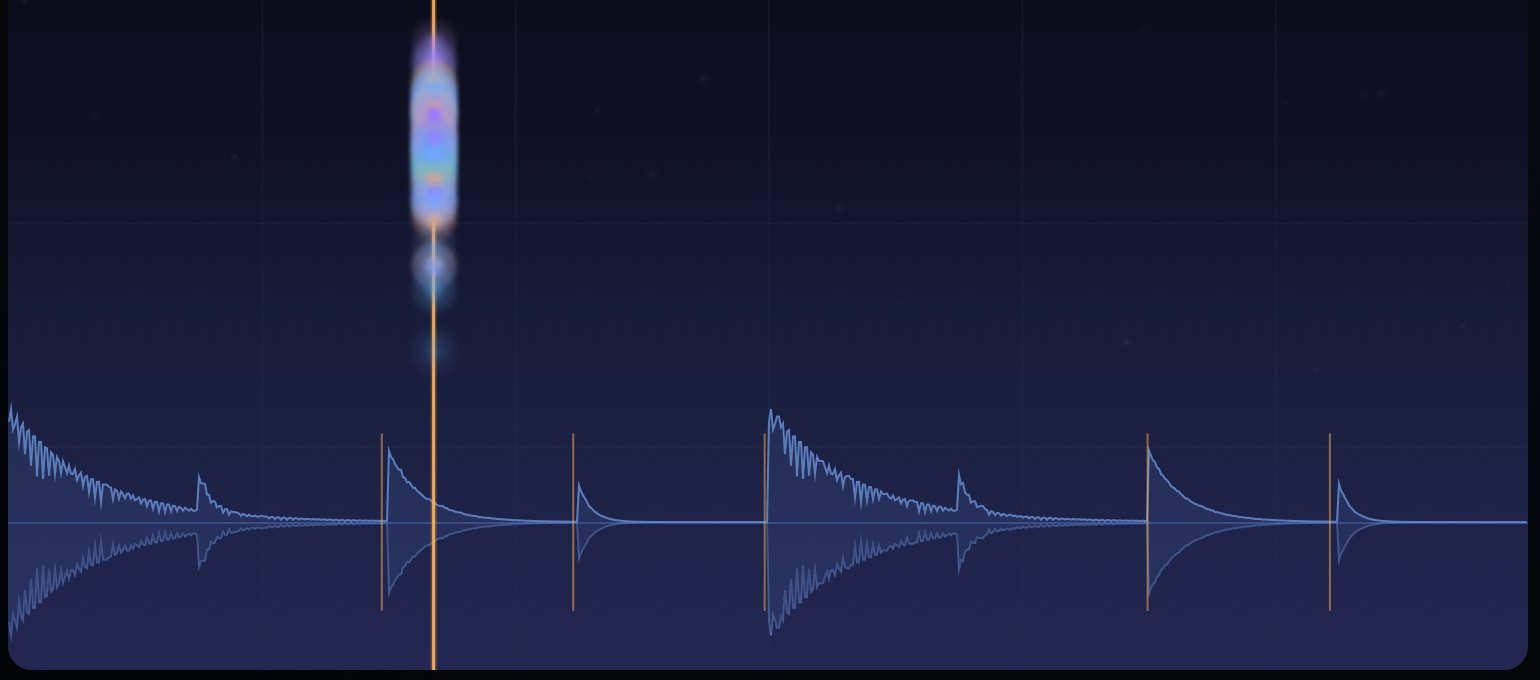
That sequencer is the part with no real equivalent on the other side. Each step can point at a different slice, be switched off so the groove changes shape rather than developing a hole, and carry its own offset, level, pitch and probability, with the dice seeded so a 40% step still bounces identically every time. Its ceiling is sixteen steps, which is worth saying out loud in a comparison: this is a phrase generator, not a full pattern sequencer. Add COHERE, which locks grain timing to the sample's own pitch and folds a cloud into a playable tone, and MORPH, which takes grains from a second sample with an option to transpose it onto the first one's key, and the shape of the thing is clear: it is about doing things to a recording.

Side by side
| Quanta 2 | Murmur | |
|---|---|---|
| Shape | Synth with a granular oscillator | Instrument built around a sample |
| Extra sound sources | Two VA oscillators, noise | A second sample layer via MORPH |
| Filters | Dual multi-mode, 2 and 4 pole, serial or parallel | Per-grain filter, plus the FX rack |
| Envelopes | Four, up to 99 steps each | Three, with draggable slope curves |
| Slicing and step sequencing | Not its focus | Slices per key, plus the WALK sequencer |
| Grain engine | Up to 100 grains per voice, up to 1 s each | 10 to 500 ms grains, 0.5 to 200 per second |
| Platforms | Win, macOS, Linux, iPad | macOS, Windows |
| Formats | CLAP, VST3, AU, AAX, LV2, AUv3 | VST3, AU, standalone |
| Free version | No | Yes, the whole grain engine, no expiry |
| Price | $129, perpetual, no DRM | $34.99, one off |
Quanta figures are from Audio Damage's own product page, checked on 19 August 2026. Both products get updated and discounted, so check rather than trusting a table you found in a search result.
How I would actually choose
Buy Quanta 2 if you want a synthesiser. If the appeal is filters and oscillators and modulation, if you would use those 99-step envelopes, if you are on Linux or iPad, or if you want granular to be one voice in a patch rather than the whole patch, it is the deeper instrument and the extra money is buying something real.
Buy Murmur if the recording is the point. If you are chopping a break onto keys, walking a phrase through slices, morphing one sample into another or holding a field recording open as a bed, that is what it was designed around, and it costs a good deal less. The free version means you can settle it yourself in an afternoon without spending anything, which is the recommendation I would give anyone reading a comparison written by someone with a stake in the answer.
If you are still working out whether granular suits your music at all, start with the explainer rather than either product page. Also worth knowing that Output's Portal gets compared to both of these and is a different kind of thing again: an effect rather than an instrument.
Source: Audio Damage's Quanta 2 page.